

15 May 2026–27 Federal Budget: Tax and Accounting Implications for Medical Practice Owners in Australia
A note for Aspire clients: this is our full technical analysis of the 2026–27 Federal Budget. I’ll be in touch about what applies specifically to your practice — this post gives you the complete picture behind that conversation.
If your practice structure was set up more than three years ago, the 2026–27 Federal Budget has likely made it less efficient — and may trigger new tax obligations by 2028 that defeat its original purpose. I’ve advised medical practices through fifteen Federal Budgets. This one is different.
Three structural reforms hit the way private medical practices are actually organised: discretionary trust taxation, capital gains tax, and Medicare-linked compliance enforcement. Together they ask every principal to review their structure, their compensation mix, and their compliance posture before 30 June 2027.
If you operate through a service trust, hold an investment property, or expect to sell or hand on the practice within the next decade, you have material work to do in the next twelve to eighteen months. The rollover relief window the Government has provided — a 36-month CGT-neutral path to restructure — is the operational corridor. It opens on 1 July 2027 and closes on 30 June 2030.
Key Takeaways
- Discretionary trusts face a 30 per cent minimum tax from 1 July 2028
- A CGT-neutral restructure window opens 1 July 2027 — closes 30 June 2030
- Division 296 tax on super balances above $3 million is now law — applies from 1 July 2026
- $20,000 instant asset write-off is now permanent for small business
- ATO real-time monitoring is live — documentation discipline is non-negotiable
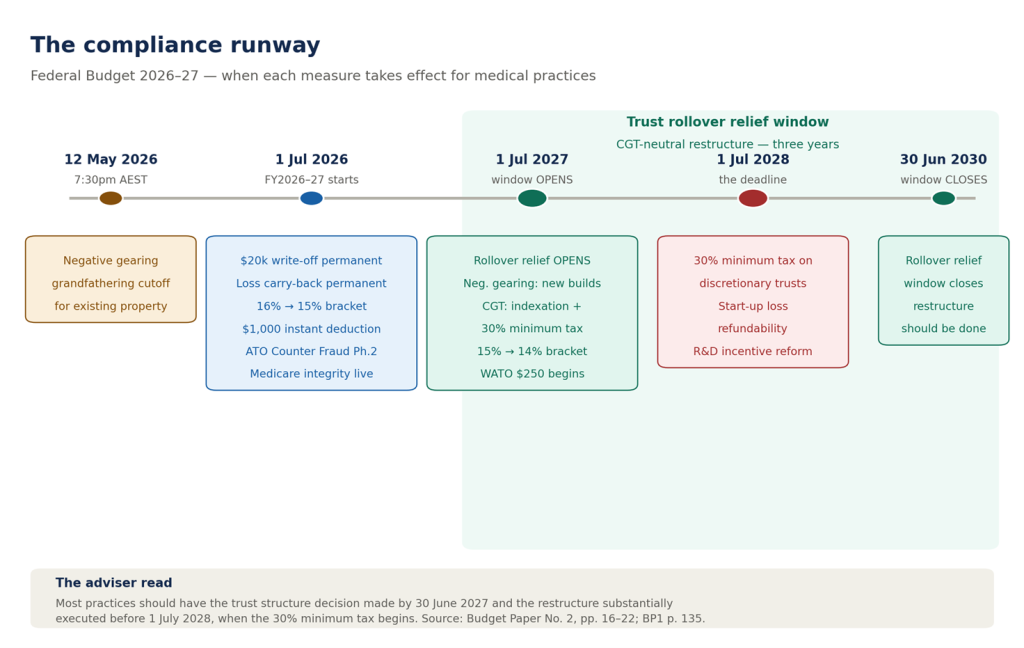
Figure 1: The compliance runway — when each Federal Budget 2026–27 measure takes effect for medical practices. Abbreviations: CGT = capital gains tax; WATO = Working Australians Tax Offset; PAYG = pay as you go; R&D = research and development
Plain-English glossary
- Discretionary trust — a trust where the trustee decides each year who receives the income; the common structure for a medical practice service entity or a family investment vehicle.
- Service trust (service entity) — a trust that provides premises, staff and administration to the practising doctors for a fee — the classic “Phillips” arrangement.
- Bucket company — a company set up to receive trust distributions and cap the tax rate on retained profit.
- Division 7A — the tax rule governing loans and payments from a private company to its shareholders or their associates.
- Division 152 — the four small business capital gains tax concessions available on the sale of an active business asset.
- Division 296 — the new tax reducing super concessions on total superannuation balances above $3 million, applying from 1 July 2026 (the 2026–27 income year).
- Cost base indexation — adjusting an asset’s purchase cost for inflation to work out the taxable capital gain; replaces the 50 per cent CGT discount from 1 July 2027.
Here is what changed, and what to do about it.
Trust Structures Are Changing — Here’s What That Means for Your Practice
The headline measure is the 30 per cent minimum tax on discretionary trusts from 1 July 2028 (Budget Paper No. 2, p. 22; Treasury fact sheet — Minimum Tax on Discretionary Trusts, p. 1). The trustee pays it. Beneficiaries continue to include distributions in their personal returns and receive non-refundable credits for the trustee’s tax.
The classic medical-practice play — using a service trust to stream surplus to family members on low marginal rates — is materially curtailed below 30 per cent. The bucket-company strategy is broken: corporate beneficiaries receive no credit for the trustee tax, so cycling income through a Pty Ltd to defer through complying Division 7A loans no longer works the way it does today.
Fixed (unit) trusts, widely held trusts, complying super funds, special disability trusts, deceased estates and charitable trusts are excluded outright. Testamentary trusts are treated more narrowly: only income from assets held by a testamentary trust already in existence at Budget night (7:30 pm AEST, 12 May 2026) is excluded. Testamentary trusts created under a will where death occurs after that date — and new assets acquired by an existing testamentary trust after that date — are intended to be caught by the 30% minimum tax. If your estate plan relies on a testamentary trust for income-tax efficiency, it should be reviewed; the asset-protection and bloodline-protection benefits are unaffected, but the tax benefit is materially curtailed for anything established or acquired post-announcement. Primary production income and amounts subject to non-resident withholding tax are also out of scope. The four small business CGT concessions in Division 152 are preserved unchanged — critical for sale and succession planning.
The rollover relief window from 1 July 2027 to 30 June 2030 is the response: a CGT-neutral path to restructure out of a discretionary trust into a Pty Ltd company or a fixed trust (BP2 p. 22). The ASBFEO is available from 1 January 2027 to support the work; ASIC has specific arrangements to assist incorporations.
Alongside this, negative gearing on residential investment property is limited to new builds from 1 July 2027, and the 50 per cent CGT discount is replaced by cost base indexation plus a 30 per cent minimum tax on real capital gains from the same date (BP2 p. 21; Treasury fact sheet — Negative Gearing and CGT Reform, pp. 1–4).
Properties acquired before 7:30pm AEST on 12 May 2026 are grandfathered. Properties acquired between 12 May 2026 and 30 June 2027 retain negative gearing during that window only. Commercial property is unaffected — practice premises ownership in personal names becomes relatively more attractive as a reinvestment vehicle.
For most clients, this combination means three jobs:
- Decide where the discretionary trust ultimately goes — fixed trust, Pty Ltd, or stays and pays.
- Inventory grandfathered investment property and confirm which acquisitions sit pre-announcement.
- Review whether the principal’s compensation mix (salary versus distribution) captures the new $250 Working Australians Tax Offset from 2027–28 and the $1,000 Instant Tax Deduction from 2026–27 onwards (BP2 p. 16, p. 19).
Division 296 Is Now Law: What High-Balance Practice Owners Must Know
The 2026–27 Federal Budget itself adds nothing new in headline super policy. What matters is the confirmation that the Better Targeted Superannuation Concessions — the “Division 296” tax on super balances above $3 million — is now law: it received Royal Assent on 13 March 2026 via the Treasury Laws Amendment (Building a Stronger and Fairer Super System) Act 2026. It applies from 1 July 2026 — the 2026–27 income year (ATO, Latest news on tax and superannuation law and policy, updated 12 May 2026; BP2 p. 143; BP1 p. 135). The associated increase to the Low Income Superannuation Tax Offset applies a year later, from 1 July 2027.
For a $400,000–$800,000-earning GP or specialist with twenty-plus years of concessional contributions and an SMSF holding business real property — the consulting room, the practice premises — this is the live issue.
The Act incorporated “practical changes” during its parliamentary passage; verify the unrealised gains treatment for illiquid SMSF assets in the legislation itself before relying on prior commentary.
The opportunities are unchanged: concessional contributions remain concessionally taxed, the contribution caps are unchanged in primary sources, the SG rate sits at 12 per cent, and the transfer balance cap continues its existing indexation.
The risk is that high-balance clients approaching or above $3 million now wear an additional layer of earnings tax that the policy does not index. Model the trajectory honestly: for a principal at $2.6 million today with a normal contribution profile, $3 million is two to three years away.
Not in the 2026–27 primary sources: no change to Division 293, no change to non-arm’s-length income or expense rules, no change to SMSF in-house asset or sole purpose rules, and no new Payday Super announcement.
Permanent Write-Offs, Loss Carry-Back, and Where to Reinvest
A handful of structural concessions made permanent, plus sharper incentives for newly incorporated practices.
The $20,000 instant asset write-off is made permanent from 1 July 2026 for small business entities with aggregated turnover under $10 million (BP2 p. 20). This is planning rather than year-by-year scrambling.
Dental chairs at the lower end, ECG machines, sterilisers, examination couches, IT — all immediately deductible per asset. Larger capital items continue into the simplified depreciation pool. The five-year re-entry suspension is extended to 30 June 2027, giving practices that previously opted out of simplified depreciation a window back in.
Two-year loss carry-back becomes permanent for all companies with aggregated turnover under $1 billion, from 1 July 2026 (BP2 p. 20). Revenue losses only. Limited by the company’s franking account balance — the standard integrity rule. Direct cash-flow relief for any practice posting an accounting loss in a fit-out year or relocation year.
Loss refundability for newly incorporated start-up companies in their first two years, capped at FBT and PAYG withholding remitted on Australian employees, from 1 July 2028 (BP2 p. 20). Newly incorporated practices with employed staff (not contracted) get effectively a refund of their employer-side tax remittances in loss years. Directly rewards employment over contracting in the early years.
Monthly PAYG instalments opt-in from 1 July 2027, with ATO-approved dynamic calculations and interest charges removed for accidental variation errors made using ATO calculators (BP2 p. 20; Treasury fact sheet — Backing Small Businesses, p. 5).
Practices with seasonal cash flow — dental end-of-financial-year surges, GP flu-season peaks — benefit from instalments that track actual activity rather than prior-year baseline. Note the enforcement edge: practices with a non-compliance history can be conscripted into monthly reporting.
Reinvestment-wise, the picture is now clearer. Residential investment property loses its longstanding tax benefit unless it is a new build. Commercial property — including practice premises — does not. Shares and managed funds shift from 50 per cent discount to indexation plus 30 per cent minimum.
Holding-period strategy matters less; real return matters more. For a principal weighing reinvestment between an investment property and the practice premises freehold, the structural answer has just shifted toward the premises.
The ATO Is Watching More Closely Than Ever — Here’s What’s on the Radar
The Budget allocates $86.3 million over four years to a Phase 2 Counter Fraud Strategy with materially expanded ATO powers (BP2 p. 14). Three things change operationally.
First, real-time monitoring of tax agent and business account access becomes live. The ATO can intervene while transactions are happening, not only review them in arrears. Tax-agent-side integrity sits inside the active surveillance frame.
Second, garnishee powers expand to include jointly held assets where the structure is being used to frustrate recovery. For practices with spouse-and-principal joint titles on investment property or business real property, the documentation of arm’s-length rationale matters more than it has historically.
Third, Medicare audit exposure now has a direct P&L impact — and that makes it an accounting conversation, not just a clinical one. The Medicare integrity package allocates $146.8 million over four years across the Department of Health, Disability and Ageing and Services Australia, with $674.1 million projected in fraud and non-compliance recovery (BP2 p. 110). The Government has explicitly costed $146.3 million in MBS savings from avoided duplication over two years from 1 July 2026, meaning the ATO and Services Australia are operating with a recovery-based mandate. From an accounting perspective, this changes the cost-of-error calculation on billing decisions — documentation, item-selection rationale and supporting evidence per encounter become P&L line items, not clinical paperwork.
The ATO is also receiving substantial implementation funding tied to the new measures: $90.7 million over five years for NG/CGT reform administration, $66.0 million over five years for the trust minimum tax, $58.2 million for loss carry-back and refundability.
Cumulatively, this is the most significant compliance-side funding increase in several years. The same population that will be restructuring under the rollover relief window is the population the ATO is actively monitoring. Trustee resolutions, beneficiary entitlements, service-fee benchmarking, family-employment contracts — all need to withstand scrutiny.
At a Glance: The Tax Impact Scorecard
Every major measure, with a plain verdict for a privately owned medical practice, the effective date, the implementation status, and the action it calls for.
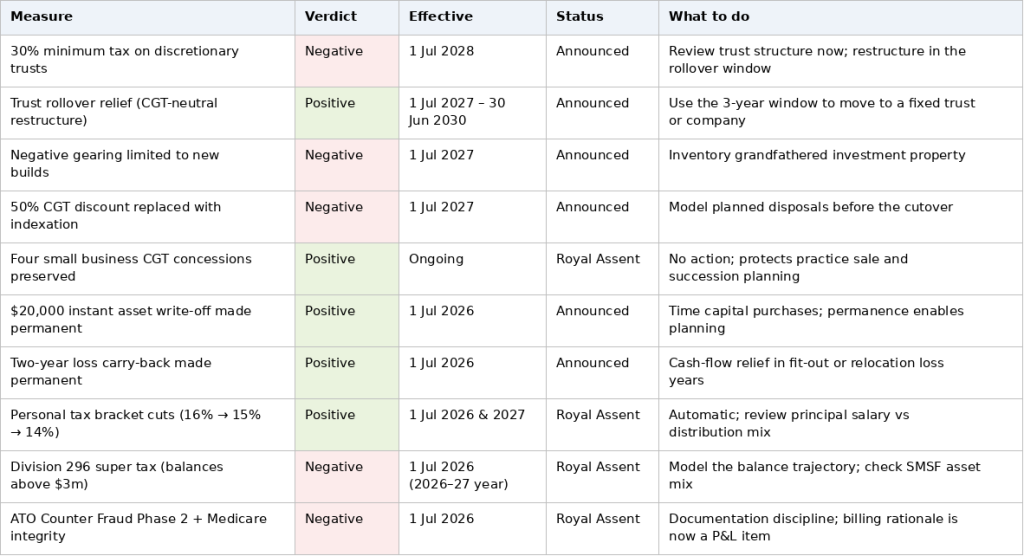
Figure 2: Tax Impact Scorecard — verdict for a privately owned Australian medical practice. Source: Budget Paper No. 2, pp. 14–22, p. 110; BP1 p. 135.
Your Pre–30 June 2027 Action Checklist
- Trust structure review. Every client with a service trust or family discretionary trust needs an options paper by Christmas 2026. Three viable destinations: fixed unit trust, Pty Ltd company, or maintain-and-pay. Restructure execution should sit in the 1 July 2027 to 30 June 2030 rollover window.
- Investment property review. Work out which of your investment properties are grandfathered — that is, bought before the 12 May 2026 announcement, and therefore still covered by the old negative gearing and CGT rules. For any property you might sell, compare the tax outcome of selling before 1 July 2027 against selling after: a sale that settles before that date still attracts the full 50 per cent CGT discount on the gain. Separately, if you’ve owned your practice goodwill or premises for close to 15 years, it can be worth timing the sale to reach the 15-year mark — at that point the gain may be exempt from CGT entirely.
- Billing documentation discipline. From 1 July 2026, automatic data-matching identifies duplicate imaging and pathology billing. Item-selection rationale and supporting evidence per encounter need to be captured at the time — these are now P&L items, not clinical paperwork.
- Principal compensation mix review. Salary versus distribution mix now affects WATO eligibility, the $1,000 instant tax deduction, and personal-bracket benefits. For most principals, a deliberate salary component captured through a Pty Ltd structure is more efficient post-reform than pure trust distribution.
- Super balance trajectory check. Division 296 is law and applies from 1 July 2026 — the 2026–27 income year. For principals approaching $3 million in total super balance, model the trajectory and the SMSF asset mix. Practice premises held in SMSF need particular attention to the unrealised gains treatment in the Stronger and Fairer Super System Act.
Which Changes Matter Most for Your Practice Type
Priority varies by structure. Find your practice type and read across — a Group GP with a service entity carries a very different load to a sole practitioner.
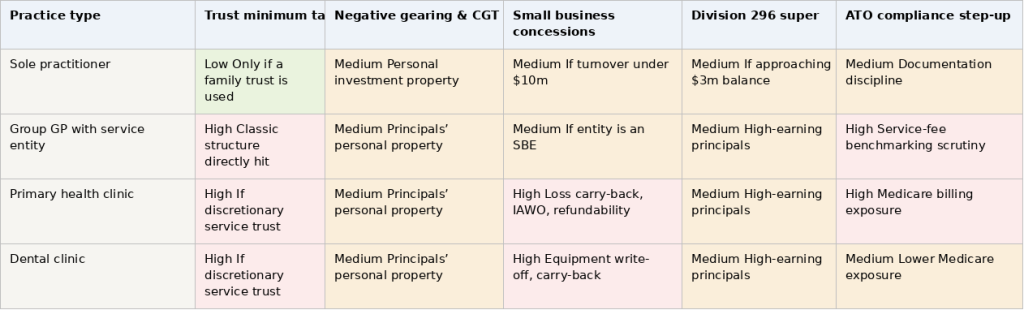
Figure 3: Tiered Action Matrix — High = act this year, Medium = review, Low = monitor. Bulk-billing vs mixed-billing does not change tax-side eligibility; it changes margin sensitivity. Source: Budget Paper No. 2, pp. 14–22, p. 110; BP1 p. 135
Let’s review your structure before 30 June 2027
This Budget rewards the practices that move early. The structural reforms — discretionary trust taxation, CGT, and the ATO compliance step-up — work cleanly only with deliberate restructuring inside the rollover relief window, careful investment property positioning before 1 July 2027, and documentation discipline starting now.
As an Aspire client, your structure review against the 2026–27 changes is already part of your service. If you want to bring the conversation forward — particularly if you operate through a discretionary trust, or are within five years of a sale or succession event — get in touch with me directly.
For a downloadable PDF copy of this information – please click here.
If you have questions, please contact Praba:
P: (03) 9853 3007
E: praba@aspirepartners.com.au
This article is general commentary only and does not constitute specific tax, financial or legal advice. Every measure flagged here is subject to legislative passage where the status is “Announced”. Speak with your adviser before acting on any of it.